Labour Market Information
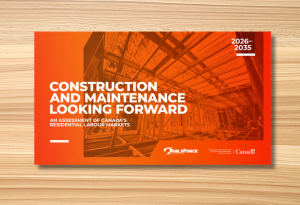
BuildForce Canada Report: 21% of workforce retiring by 2035, with shortfall of new entrants projected
On July 20, 2026, BuildForce Canada, with whom CHBA works extensively, released its 2026–2035 Construction and Maintenance Looking Forward: An Assessment of Canada’s Residential Labour Markets. The report findings illustrate the long-term workforce challenge ahead for the residential construction sector. Approximately 21% of the workforce – or 135,000 residential construction workers – is projected to retire by 2035, departing the sector with decades of work experience. BuildForce projects a shortfall of new entrants over that same period, which will result in Canada not having enough workforce capacity to double housing starts and build the approximately 480,000 homes per year over the next decade that are needed to close the housing supply gap and help restore affordability. The outlook reinforces the need for governments to work with industry to build a stronger, more flexible workforce capable of meeting the country’s housing supply targets. Read CHBA’s press release here (with link to report), which includes our labour force recommendations to the federal government.
BuildForce Immigration Report for Construction Sector Proposes Immigration Reform
BuildForce Canada has released a report, in which CHBA was heavily engaged, on immigration and the construction sector in Canada, which details Canada’s populations trends and how immigration has become the primary driver of population growth. Current challenges and future pressures on the labour force are described, including the federal government’s planned mega infrastructure projects, its focus on building more housing to address affordability and its net zero targets. The report maps this out against the evolution of Canada’s immigration system over the past fifty years, which has moved from an approach designed to fill labour force gaps to one that now favours those who are highly (university) educated, and the negative consequences this has had for the construction sector. Four overarching recommendations for needed immigration reform are outlined in the report, which CHBA was pleased to contribute to through the report Steering Committee. The recommendations involve working with industry, and the provinces/territories to better target immigration needs and help facilitate labour market integration for those we do welcome to Canada. Read BuildForce’s Immigration Report Update (March 2024) here.

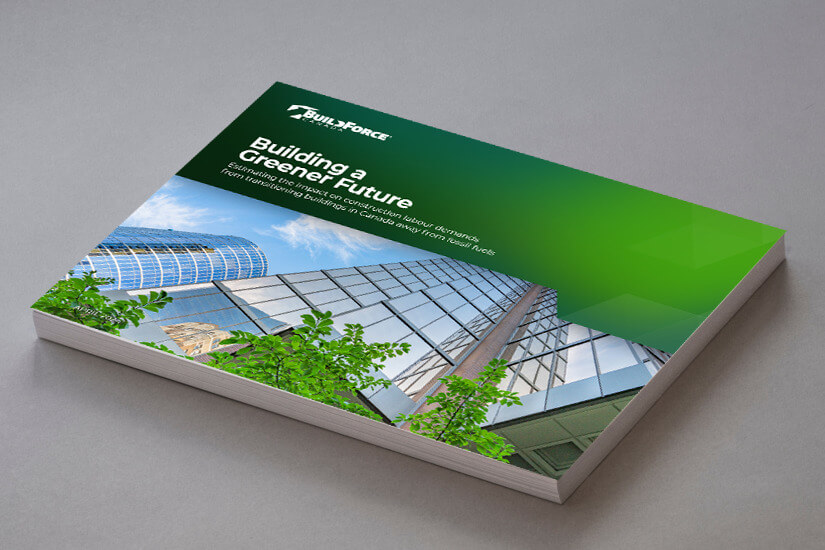
BuildForce Canada Greener Future Report: Significant additional labour force needed to address Canada’s net zero aspirations
On April 25, 2024, BuildForce Canada released its Building a Greener Future: Estimating the impact on construction labour demands from transitioning buildings in Canada away from fossil fuels. The report examines the labour force requirements of retrofitting existing buildings to improve their energy efficiency and reduce their carbon footprints in support of the Government of Canada’s goals to achieve net-zero greenhouse gas emissions by 2050, focusing on two main green-building activities are performed: converting space and water heating equipment from fossil fuels to electric power sources, and retrofitting buildings to improve energy efficiency and minimize heat loss. Although the report necessarily assumes that there would be sufficient power generation and grid capacity for residential housing (which there is not), it provides a sense of the magnitude of the goal and points to the challenges that need to be addressed, finding that as many as 16,300 new jobs relating to fuel switching could be created in the residential sector alone, while a further 40,600 may be created to perform energy-efficiency retrofits. Read BuildForce Canada’s press release (with link to report) here.